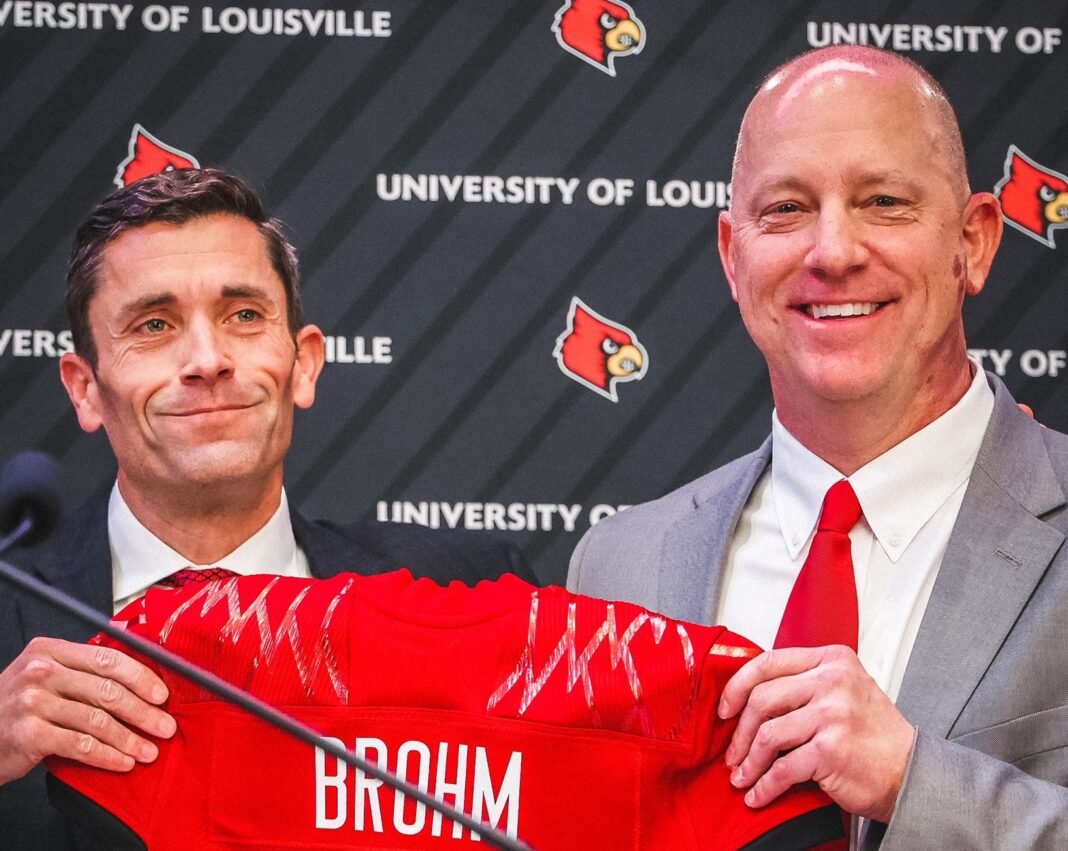
Let there be no doubt. University of Louisville fans are still savoring that 24-21 win over Miami. Ranking high among Coach Jeff Brohm’s growing list of achievements since returning to his alma mater three years ago.
Huge win witnessed by 3.4 million fans on ESPN last Friday, propelling UofL into the top 20 this week.
Too many analysts and everyday fans have described UofL’s win as “an upset.” A term often used, vastly overused, when an underdog defeats a higher ranked team. The description is used over and over during TV score reporting.
How many “upsets” can there be? Kind of insulting when one ponders the assumptions behind the term. As if the underdog is content with its role, with no expectations beyond losing. Why play the game when the outcome is already determined?
The win over second-ranked Miami was Brohm’s first over a top five team during his Louisville tenure. At Purdue, during his previous stint, the Boilermakers knocked off No. 2 Ohio State in 2018, No. 2 Iowa in 2021, No. 3 Michigan State in 2021). He is now 4-4 all-time against top five teams.
Football is an obsession with Brohm, and UofL football, especially, is his passion. He played quarterback at UofL, his brother Brian played quarterback for UofL, his dad Oscar played quarterback at UofL and his brother Greg was a wide receiver for UofL. His son Brady is on the current staff. Football was as popular as roasted turkey during Brohm family Thanksgiving Day celebrations. He gave up a Big 10 coaching position to return to Louisville.
This is where he wants to be and there should be no doubt that he is in it to win. In fact, he has enormous dreams for his Louisville teams. Was anyone surprised last season when Louisville dominated Clemson 33-21 for UofL’s first ever win in 12 tries against the Tigers?
So there should be no surprise when Brohm emerges victorious in one of these showdowns, regardless of where his team is ranked. Based on his record, he has a 50-50 chance of winning. Regardless of its ranking or won-lost record. In other words, he has won so often that the outcome should not be considered an upset.
There are other reasons as well.
-
Rankings don’t always reflect true team strength.
College football rankings are subjective and can lag behind reality. A “lower-ranked” team may actually be stronger based on matchups, recent performance, or home-field advantage. Calling a win an “upset” implies inferiority that may not exist. -
“Upset” diminishes the winning team’s legitimacy.
Labeling the result an “upset” can make it sound as if the victory was a fluke rather than the result of preparation, strategy, and execution. “Upset” overlooks the possibility that the winning team simply played better that day. -
The term reflects betting or media bias, not competition.
“Upset” often stems from pregame odds or media expectations rather than the team’s actual capabilities. Downplaying the win reinforces those external narratives instead of focusing on the game’s reality. -
College football parity has increased.
In the modern era of the transfer portal and NIL deals, talent is more evenly distributed. Lower-ranked teams can compete with anyone, making the notion of an “upset” less meaningful.
In short, calling a win an “upset” assumes surprise or improbability — but when a Jeff Brohm team is well-prepared, talented, and simply better on the field, a win isn’t an upset at all — it is earned.